
Exploring Neurodiversity
Tools, Knowledge & Practice by NeuroXYZ
XyZ @ NeuroXYZ / NeuroBridge

About Me
XyZ
- Autistic adult
- Creator & maintainer of NeuroXYZ (solo, hobby project)
- Neurodiversity advocate
- Interested in disability justice & neurodivergent Marxism
- Recent hobby: 3D printing
Related Projects
- NeuroXYZ — Tools + Wiki knowledge platform
- NeuroBridge (脑脑空间) — Decentralized ND community
Today's talk: Tools · Knowledge · Practice · Localization
Why NeuroXYZ?
Background
- Systematic neurodiversity resources in Simplified Chinese remain scarce
— with thanks to pioneers like Qingshan Neuro (青衫Neuro) - Existing self-report tools are mostly in English / paid or have access barriers
- Wanted to build a free, open, Simplified Chinese toolkit
Core Principles
- De-commercialized — free and open
- Simplified Chinese — translated + localized
- Neurodiversity-affirming — presenting multiple perspectives
Personal website · Non-commercial · neuroxyz.cn
Design Philosophy & Principles
Knowledge Stance
- Grounded in the neurodiversity paradigm, critically reflecting on the normativity paradigm
- Tools are for exploration, not diagnosis
- Neurodiversity-affirming while not ignoring the disability perspective
- Attention to systemic issues — structural inequality and historical problems
Design Principles
- Transparency — sources, validity, and verification status are labeled
- De-authoritative — not "the expert tells you the answer"
- Accessibility — free, in Chinese, no registration required
- Autonomy — users explore and choose for themselves
Stay vigilant about two things:
"Weaponized heterogeneity" — using "different groups have different needs" to dissolve collective demands
Neurodiversity-Lite — superficial appropriation of terminology, depoliticized mainstream co-optation
Three Main Sections
Tests
Neuro Traits · Psychometrics
Children · Tools
Fun · Resources
30+ self-report tools · instant results
Wiki
317 pages of systematic knowledge
6 major sections · reading pathways
Author database · reference library
From foundations to critique · from history to practice
Resources
Emotion visualization tools
ND burnout toolkit
External links & materials
Free · no registration · Simplified Chinese
Tests & Tools (6 Categories)
01 Neuro Traits
CATI · AQ · RAADS-R · Q30
CAT-Q · EDA-QA · RBQ-2A
8-Sen · MAIA-2
PAQ · PES · ACOS
NSAC-30 · ND Burnout ·
AABS-R14 NEW!
02 Psychometrics
IPIP-120 Big Five Personality
ITQ Trauma Questionnaire
ITQ-CC NEW! Clinical Checklist
RIS Insomnia Index
Emotion Wheel Interactive Visualization
03 Children
AQ-C Child · AQ-Adol Adolescent
MAIA-Y · RBQ-3 · EDA-8
ITQ-CA Child Trauma
ITQ-CG NEW! Caregiver
GADC Gifted/ASD Checklist
04 Tools
Emotion First-Aid Kit Grounding
Emotion Wheel · Decision Tree
Working Memory ·
Feeding Game Attention
ND Translate Browser Plugin
DBT Workbook · Typesetter
05 Fun
PhiType Philosophy Quiz
Bingo Autism Bingo
ND-16type ND Stance Profiler
JingJue Ancient Divination
MAGI System EVA Simulator
06 Resources
Articles & Guides
Camouflaging Handbook
Neurodiversity Approaches
ND: A Very Short Introduction
External Sites & Tools
30+ tools · 6 categories · no registration · instant results · web: no server storage
Wiki Knowledge Base
I · Foundations
Neurodiversity · Pathology paradigm · Disability models · Neurodivergence · Neurotypicality · Movement
II · Critical Analysis
Neuronormativity · Depathologization · Capitalism critique · Neurodiversity-Lite · Social model · Affirmation model · Intersectionality · Decolonization
III · Historical Context
Invention of normalcy · Eugenics · Anti-psychiatry · History of the ND movement
IV · Experience & Practice
Double empathy · Camouflaging & masking · Burnout · Inclusive education
V · Diagnosis & Phenomena
ASD · ADHD · PDA · Alexithymia · BAP
Reading Pathways
Just heard about it · Wondering if I'm ND · Took a test, want to understand the results · Academic research
Full reading roadmap →
Knowledge Network
Interactive knowledge graph · Collaboration guide
Bidirectional links · Author database · Reference library
Robert Chapman, Patrick Dwyer, Nick Walker, Steven Kapp, and 85+ others
Emotional Support Tools
More than questionnaires — free, no-registration practical tools on the site
Emotion Wheel
Interactive emotion visualization
Explore the layers and connections of emotions
Helps with naming and expressing feelings
Emotion First-Aid Kit
5 evidence-based grounding techniques
Step-by-step guidance for urgent moments
Come back to the present when emotions surge
Emotion Regulation Decision Tree
Identify needs → match strategies
Designed for children and adolescents
Find regulation methods during distress
All free · no registration · browser-based · also available in the Mini Program
More tools at neuroxyz.cn — explore freely
WeChat Mini Program — NeuroXYZ
Why a Mini Program?
- Personal websites in China cannot collect user data ← regulatory constraints
- WeChat cloud storage + long-term tracking, results can be reviewed and compared over time
- Tabs: Home · Tools · Profile
ASD Profile
Multi-test radar chart integration · save as image
Portable Toolkit
Grounding · Emotion wheel · Decision tree · ND burnout
Assessment History
Result tracking & comparison · privacy controls
All Tests
30+ tools · search by category
Challenges: Translation & Localization
Beyond Language Translation
- Sarcasm/idiom items — different meanings across cultural contexts
- Social situation items — expression and understanding vary
- Lack of localized norm data
- Cross-cultural psychometric property differences
Cultural Impact on Measurement Structure
Take CAT-Q as an example:
- Western: higher camouflaging → poorer mental health (negative correlation)
- Japan (Oshima et al. 2024) / Taiwan (Chun-Hao Liu et al. 2026):
non-linear relationship — moderate camouflaging may be adaptive in East Asian cultures
→ Factor structure may differ across cultures; can't simply apply original dimensions
It's not "translate and done" — tools need re-validation in Chinese populations
Translation Issues: Real Examples
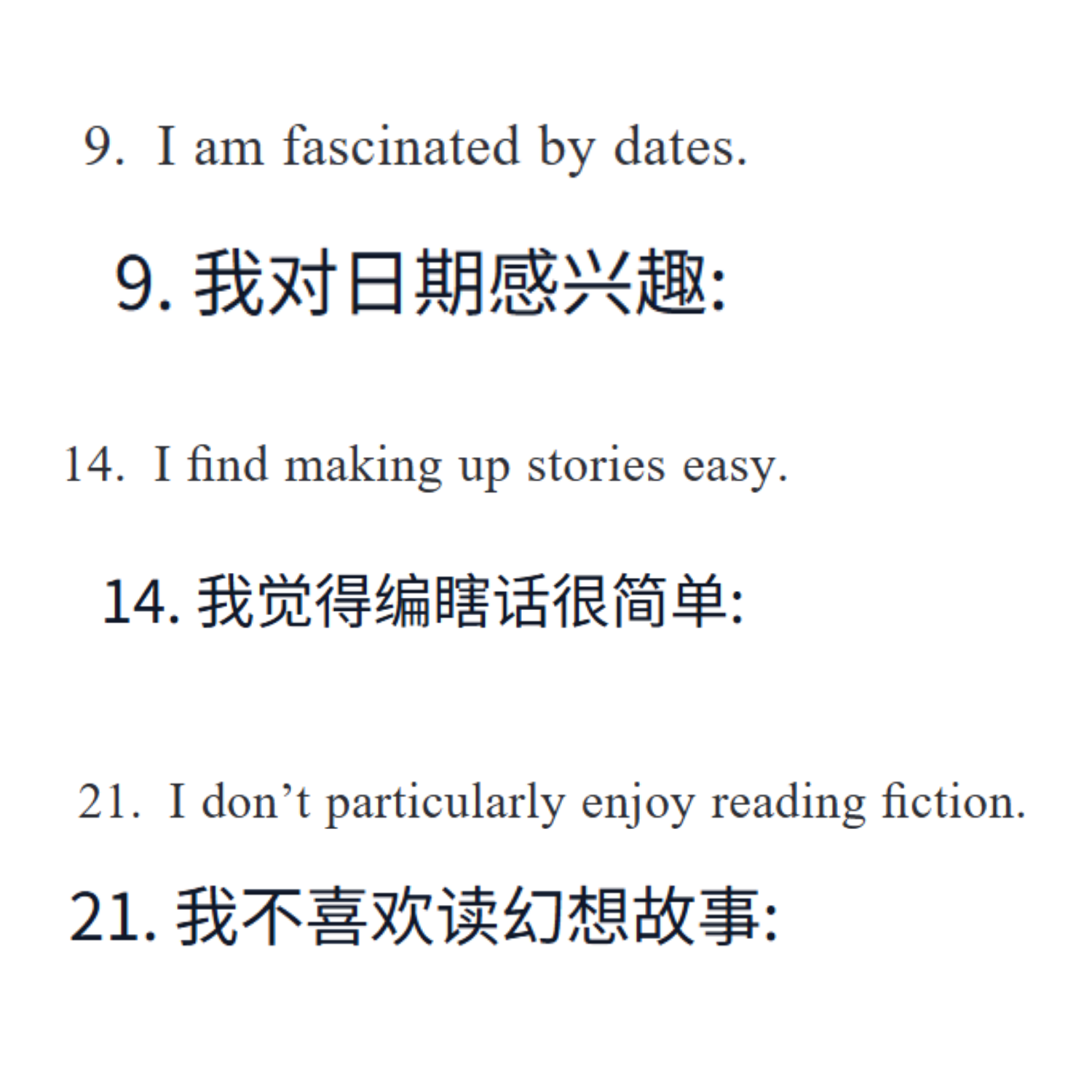
AQ — Color Conformity & Other Problems
Some translations render "making up stories" as "编瞎话" (fabricating lies)
"编瞎话" carries moral stigma in Chinese (lying/dishonesty)
The original is closer to fiction-making, morally neutral
→ If translation introduces leading connotations, it may alter measurement properties
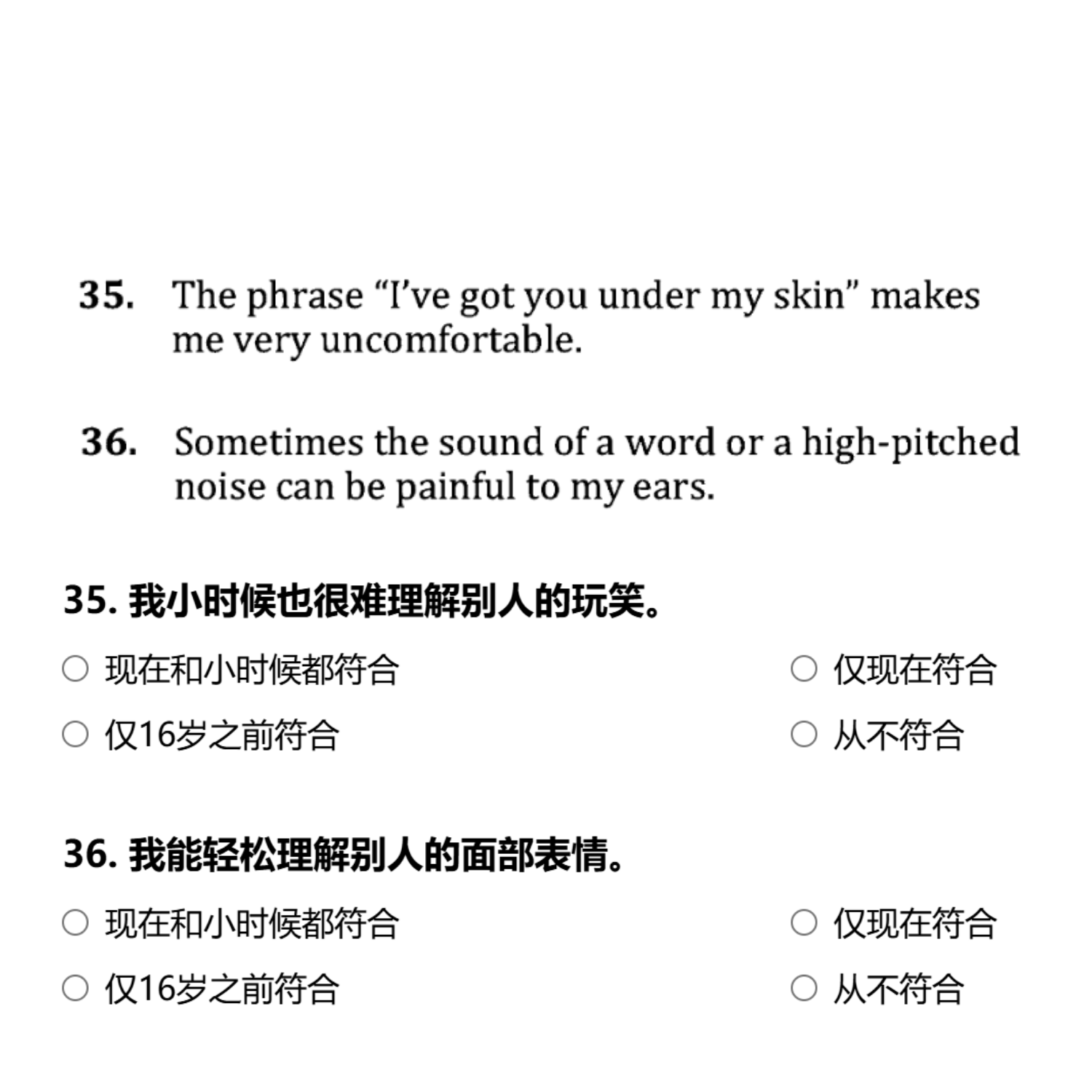
RAADS-R — Mistranslated Items
Some versions contain completely mistranslated items
Partially incorrect items → scoring confusion → misleading results
Be cautious: don't blindly trust any single translation (including mine) — cross-reference with the original and verified versions, stay critical
Self-Report Positive ≠ Diagnosis
Assuming 10% ADHD prevalence in the population
100 people · one dot each
● 10 ADHD ● 90 non-ADHD
Specificity 0.71 · Sensitivity 1.0 → 36 test positive
● True positives ~10 (1.0*100*10%)
● False positives ~26 (0.29*100*90%)
● Negatives ~64 (0.71*100*90%)
Example: ASRS v1.1
The most commonly used ADHD screening tool
Specificity ~0.71 — 29% of non-ADHD individuals also screen positive
Sensitivity 1.0 — almost never misses ADHD
(Hines, King & Curry, 2012)
Even if ADHD prevalence is as high as 10%,
out of 100 who screen positive
~72%
are NOT ADHD
Screening ≠ diagnosis
In low-prevalence populations
false positive rates are extremely high
Challenges as a Solo Advocate
Validation Dilemma
- Difficult to conduct standardized translation-backtranslation procedures
- Translations largely lack formal psychometric validation
- Data collection is hard — insufficient sample sizes, self-selection bias
Copyright Limitations
- Many classic instruments are proprietary/closed copyright
- Can only use CC-BY and other open-access tools
- Respecting creators, supporting open science
Domestic Compliance
- Complex regulatory constraints: ICP filing
- Individual developers face category restrictions
- Strict limits on data collection
- → WeChat Cloud hosting as a viable path
Academic Paywalls
- Psychometric literature locked behind paywalls
- Individuals without institutional access must pay out of pocket
- Closed research outcomes are hard to turn into open tools
- → Need more open-access resources
Format Limitations
- At its core: a self-report questionnaire engine
- Cannot do structured interviews or behavioral assessments
- Subjective bias, metacognitive and language limitations
- → Future direction: task-based tools
Being transparent: most translations on NeuroXYZ have not yet undergone formal validation; individual capacity is limited
Progress & Future Directions
CATI Preliminary Validation
- NeuroBridge conference paper — workplace double empathy
- ~300-person sample validating the Chinese CATI, good performance
- No significant difference in CATI scores between self-diagnosed and formally diagnosed ASD
- → Relevant to the "self-diagnosis" debate
In Progress
- Collaborating with mainstream academics to validate CAT-Q and RAADS-R
- Seeking more collaborative validation for additional tools
- Platform labeling of translation sources and validation status
- Open discussion: community translation + academic validation
Near-Term Plans
- Localized tool validation studies
- Exploring more open tools
- Continuing Wiki content expansion
- Mini Program feature improvements
How to Get Involved
- Use & give feedback
- Contribute Wiki content — github.com/xyzhou0323/wiki
- Academic collaboration — reach out for validation studies
- Spread the word — share with those who might benefit
Thank You
Questions & Discussion Welcome